
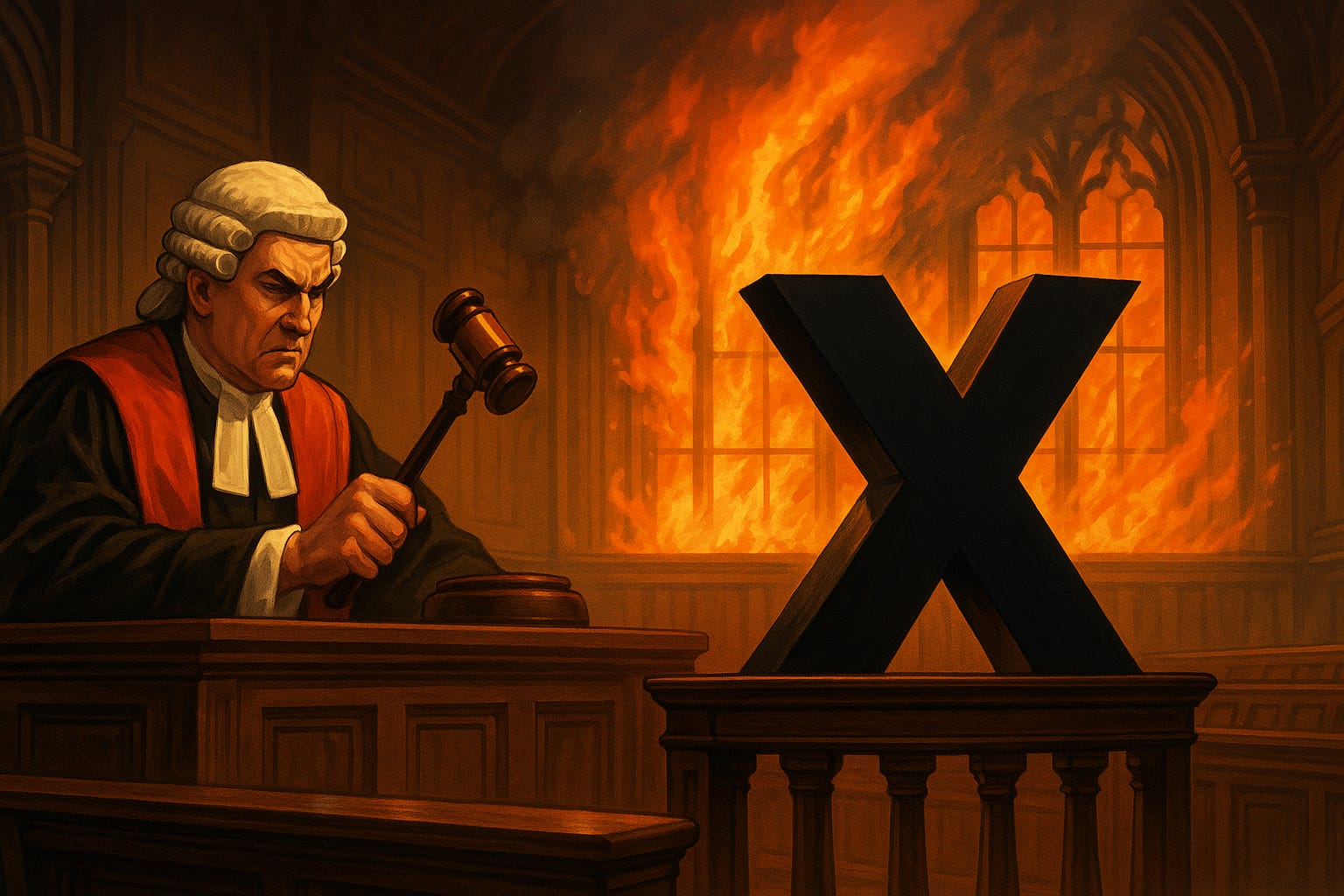
I am writing this article on the strict understanding that I am not, in any way inciting you to read it. If you feel stirred, piqued, riled or even mildly curious—stop. Your arousal is not in any way down to these words, I am merely typing. What you do with this article is down to your own free will and I disavow all responsibility.
Let’s talk about Lucy Connolly.
A year-and-a-bit ago Lucy was jailed for posting a furious, and unhinged tweet in response to the horrific killing and maiming of numerous young girls at the hands of an imported mass murderer. You can read all about the wider disturbances following the Southport murders on Wikipedia which, at the time of writing, fails to name the perpetrator of said attack, so neither will I.
“Mass deportations now,” Connolly raged. “Set fire to all the f***ing hotels full of the b******s for all I care,” and signing off “If that makes me a racist then so be it.”
Blimey.
The tweet reached around 300,000 people before she thought better of it and deleted it a few hours later — but not before the entire nation had exploded into scenes of violence and devastation.
The judge decided she had intended to incite serious violence sentenced her to 31 months in prison.
But here’s the problem: “incitement” is inexact. UK law allows for conviction for incitement to racial hatred even if no one is actually incited; the words alone are enough. And in some cases, even the intent is not required as a basis of prosecution. But Connolly was charged under section 19(1)(a) of the Public Order Act 1986, meaning the prosecution decided she had intended to stir up racial hatred in other people. And they only had to rely on the content of her tweet for prosecution, since it’s not required to demonstrate that anyone acted on her words, nor that anyone had even read them.
But for me the curious thing is the addition of the words “for all I care” and “so be it” to her message. Clearly her words were not any sort of direct command to action which lead me to think: how can we gauge the level of incitement?
And so I present the Incitement Intensity Scale—ranging from full-throated command to the kind of passive-aggressive muttering that still might get you locked up in an English jail if your timing is off.
Level 10: Imperative Hysteria
“Burn it all down. Do it now!”
Outcome: immediate arrest, straight prison, no trial, little hope of ever being released.
Level 9: Incendiary Suggestion
“Someone ought to burn this down.”
Still very much an incitement. You didn’t say to do it, but you’d be delighted if someone did.
Level 8: Implied Approval
“I’m not saying we should burn it down, but I wouldn’t cry if someone did”
Congratulations, you’re both an unreliable narrator and the newest inmate of HMP Peterborough.
Level 7: Grief-tinged rageposting
“After what happened, I wouldn’t blame anyone who torched a hotel or two.”
Still liable, especially during a “sensitive social climate,” which is always.
Level 6: Conditional Vitriol
“Mass deportations now. Set fire to the hotels for all I care. If that makes me a racist, so be it.”
Lucy Connolly’s actual tweet. You get 31 months in prison and a footnote in British legal history.
Level 5: Passive Voice Provocation
“Mistakes were made, buildings were burned, people were upset.”
Probably OK if you're presenting The Rest Is History podcast, but far too risky to post on social media.
Level 4: Satirical Deniability
“Of course, we would never burn anything down (wink).”
Depending on the context, could still count (it always will — wink).
Level 3: Rhetorical Hypotheticals
“What if someone….hypothetically….just took a flamethrower to the immigration office?”
A very clever way to get yourself arrested by trying to sound clever.
Level 2: Artistic License
“In this performance piece, the hotel symbolises oppression, and the fire represents catharsis.”
If you’re a BBC-celebrated musician, you’re best advised leaving the country at your earliest convenience.
Level 1: Sheer Nonchalance
“I don’t care if you set fire to anything.”
You’ve done nothing wrong, unless society is sufficiently on the edge, in which case make sure you always have the contact details of the Free Speech Union to hand.
What Connolly’s case confirms, at any rate, is that intent matters, but proving it is a very low bar. You and I can probably tell the difference between a genuine threat, a furious tweet, and an idiot screaming into the void, but the law apparently cannot. It’s not what your words do, it’s what a judge thinks they meant.
And whatever you do, don’t pair your angry words with an image of the Court of Appeal on fire. Judges might take that sort of thing personally.